Which Hearing Solutions Are Best for Classrooms?
Discover classroom hearing solutions for children with hearing loss, APD, ADHD and listening difficulties, including Phonak Roger microphones and soundfield systems.
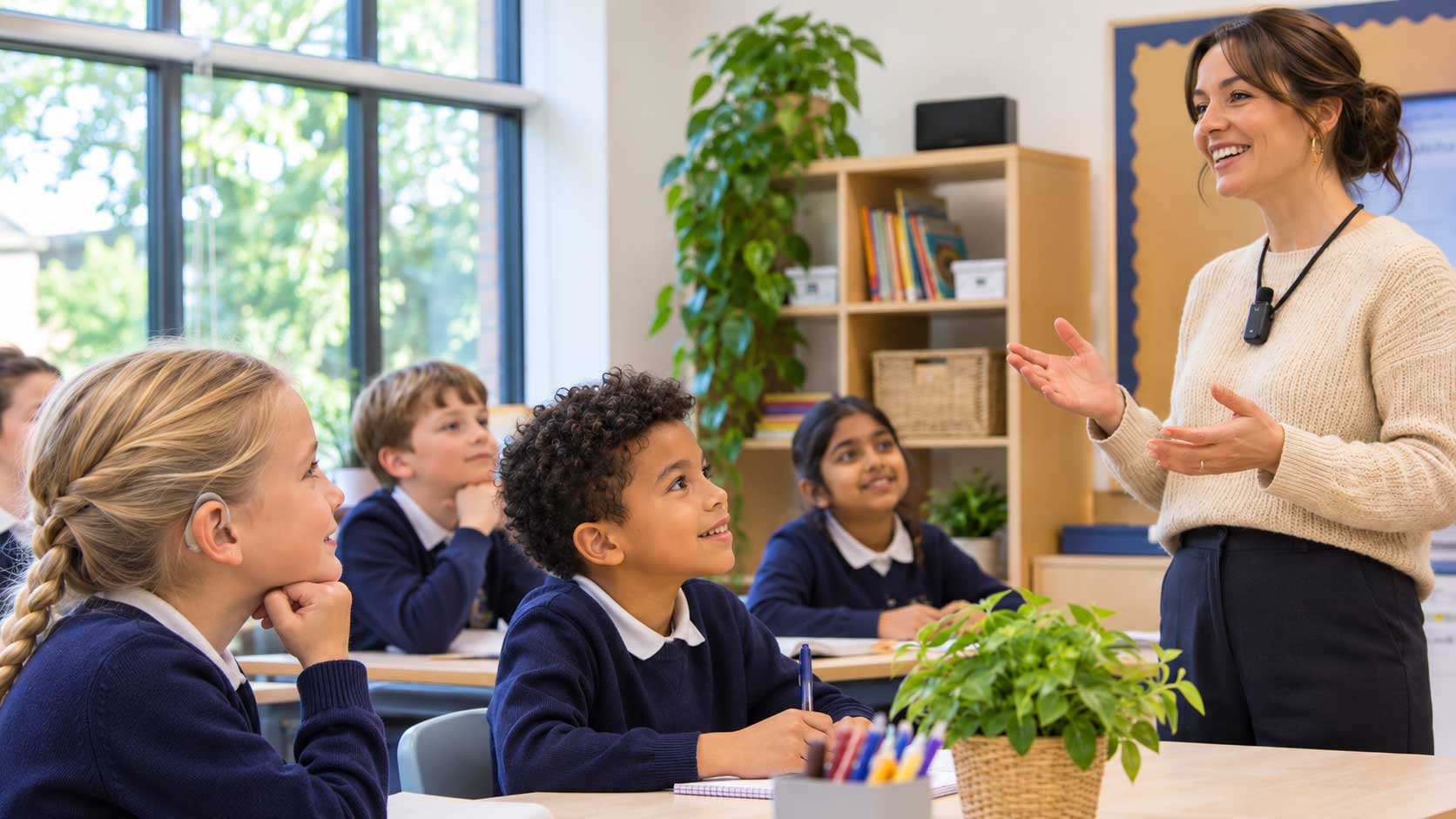
Helping Every Child Hear, Listen and Learn
A classroom can be one of the most challenging places to listen.
From the teacher explaining a new topic to pupils asking questions, group discussions, videos and everyday classroom activity, children are constantly expected to hear, understand and process information.
But what happens when the teacher's voice becomes difficult to follow?
For some children, hearing loss makes classroom communication challenging. For others, the difficulty may be associated with auditory processing disorder (APD), ADHD, autism, attention difficulties or simply the effects of background noise and poor classroom acoustics.
And importantly, a child doesn't need to have hearing loss to struggle with listening in the classroom.
Fortunately, there are several types of assistive listening technology available, ranging from personal listening devices for individual pupils to whole-classroom sound systems that help everyone hear more clearly.
In this guide, we explore the different options, how they work and which solutions may be most appropriate for individual children, teachers and entire classrooms.
Why Is Hearing in the Classroom So Difficult?
Classrooms are busy environments.
Even during a relatively quiet lesson, there may be chairs moving, pages turning, pupils whispering, equipment operating and sounds coming from corridors or neighbouring rooms.
The teacher may be moving around the room, facing a whiteboard or speaking from several metres away.
Three factors can make understanding speech particularly difficult.
Background Noise
Competing sounds make it harder to distinguish the teacher's voice from everything else happening in the classroom.
For pupils who already experience listening difficulties, filtering out these distractions can require considerable concentration.
Distance From the Teacher
Speech becomes less distinct as the distance between the speaker and listener increases.
A child sitting at the back of the classroom may receive a less clear speech signal than someone sitting directly in front of the teacher.
Reverberation and Poor Acoustics
Hard floors, windows, walls and other reflective surfaces cause sound to bounce around the room.
This reverberation can blur speech, making individual words harder to distinguish.
Together, these factors can create a challenging environment for any pupil, particularly those who already struggle with listening or attention.
Which Children May Benefit From Classroom Hearing Technology?
Assistive listening technology isn't exclusively for children with diagnosed hearing loss.
Depending on their individual needs, it may support pupils with:
- Hearing loss: Including children who wear hearing aids or cochlear implants.
- Auditory Processing Disorder (APD): Children who can detect sounds but struggle to process or interpret speech, particularly in noise.
- ADHD: Pupils who find it difficult to maintain attention when competing sounds are present.
- Autism: Some autistic pupils may benefit from improved access to the teacher's voice, although sensory preferences and sound sensitivity must also be considered.
- Unilateral hearing loss: Children with hearing loss in one ear who may find distance and background noise particularly challenging.
- Speech, language and communication needs: Where clearer access to spoken information may support learning.
- Listening fatigue: Children who become mentally exhausted from the effort of following lessons.
However, not every child with these conditions will benefit from the same equipment. The most appropriate approach depends on their listening needs, classroom environment and personal preferences.
Two Main Approaches to Classroom Listening Support
Before choosing equipment, it's useful to understand the difference between personal listening systems and whole-classroom sound systems.
Personal Listening Systems
These are designed to help an individual pupil.
A microphone captures the teacher's voice and transmits it directly to a compatible hearing aid, cochlear implant processor or dedicated listening receiver worn by the child.
This reduces the effects of distance and background noise.
Personal systems are particularly useful when one pupil requires additional support beyond what the rest of the classroom needs.
Whole-Classroom Soundfield Systems
Rather than transmitting speech directly to one child, soundfield systems distribute the teacher's voice through specially designed classroom loudspeakers.
The aim is to make speech consistently audible throughout the room without the teacher needing to raise their voice.
These systems can benefit the entire class, including pupils without hearing loss.
The important point is that these approaches aren't mutually exclusive. A school may benefit from a soundfield system for everyone while individual pupils use personal receivers for additional support.
Personal Listening Solutions for Individual Pupils
Phonak Roger Focus II: Listening Support Without Traditional Hearing Aids
One of the most interesting solutions for children who experience listening difficulties but do not wear hearing aids is the Phonak Roger Focus II.
Roger Focus II is a lightweight, behind-the-ear listening receiver designed to work with a compatible Roger wireless microphone.
Unlike traditional hearing aids, it is not designed to compensate for hearing loss through conventional hearing aid amplification.
Instead, its primary purpose is to deliver the Roger microphone signal directly to the child's ears.
How Does It Work?
The teacher wears or uses a compatible Roger microphone, such as Roger Touchscreen Mic.
The microphone captures the teacher's voice and transmits it wirelessly to the Roger Focus II receivers worn by the pupil.
Because the voice is captured closer to the teacher, the child receives a clearer speech signal with less interference from distance and classroom noise.
This can help the pupil focus on what the teacher is saying rather than continually trying to separate speech from surrounding sounds.
Who Might Benefit?
Roger Focus II may be appropriate for children with:
- Auditory processing disorder.
- Unilateral hearing loss.
- Certain listening and attention difficulties.
- Autism, where direct speech access is beneficial and the system is comfortable for the child.
- Significant difficulty understanding speech in background noise despite normal hearing thresholds.
Why Is It Different From Hearing Aids?
Roger Focus II doesn't function as a conventional hearing aid. It is a dedicated Roger receiver designed to deliver speech from a connected microphone.
It also does not eliminate background noise or block the child's awareness of the classroom.
Instead, it improves access to the important speech signal.
For pupils who hear normally but struggle to follow instructions, this can be a valuable distinction.
Zova solution: Phonak Roger Focus II paired with a compatible Roger microphone.
Phonak Roger Touchscreen Mic: Designed for Education
Roger Touchscreen Mic is one of the most versatile microphones in the Phonak education range.
It is specifically designed for classroom use and can support individual pupils as well as larger classroom listening systems.
Teacher-Worn Microphone
The teacher wears the microphone around their neck, allowing their voice to be transmitted directly to compatible receivers.
This is useful because the teacher can move around the room, face the whiteboard or work with different groups without the pupil needing to sit immediately beside them.
Small Group Mode
When placed on a table during group activities, Roger Touchscreen Mic can automatically detect speech from different directions.
This helps pupils follow contributions from their classmates rather than only hearing the teacher.
Pointing Mode
The microphone can also be directed towards a particular speaker, making it useful when the pupil needs to focus on someone further away.
Why Is This Important?
Classroom learning isn't simply about listening to the teacher.
Children also need to hear:
- Questions from classmates.
- Group discussions.
- Presentations.
- Instructions from teaching assistants.
- Collaborative learning activities.
A flexible microphone system can therefore provide support across different parts of the school day.
Zova solution: Phonak Roger Touchscreen Mic V3 with compatible Roger receivers, including Roger Focus II.
Phonak Roger On V3: A Flexible Personal Solution
Another option is Phonak Roger On V3.
Although Roger Touchscreen Mic is specifically designed for education, Roger On offers a versatile solution that may suit pupils who need listening support across several environments.
It can be worn by a teacher, placed on a desk or directed towards a speaker.
This makes it potentially useful for:
- Individual lessons.
- Tutoring.
- Small group learning.
- Homework support.
- Extracurricular activities.
- Everyday communication outside school.
For pupils using Roger Focus II or compatible hearing aids, Roger On can provide a flexible way to access speech in different situations.
For a school-wide installation, however, Roger Touchscreen Mic is generally the more appropriate starting point because of its education-specific features and compatibility with Roger Soundfield systems.
Zova solution: Roger On V3 with Roger Focus II, or with compatible hearing aids and receivers.
Whole-Classroom Hearing Solutions
Why Improving Sound for Everyone Matters
While some pupils need individual listening support, many schools are increasingly recognising the importance of improving sound throughout the classroom.
A soundfield system is designed to make the teacher's voice consistently audible across the room.
This can be particularly valuable in larger classrooms, rooms with challenging acoustics and environments where teachers need to move around frequently.
Unlike a traditional public address system, a classroom soundfield system is intended to provide controlled, even speech amplification rather than simply making the room louder.
Phonak Roger DigiMaster 5000: For Standard Classrooms
The Roger DigiMaster 5000 is a classroom soundfield loudspeaker designed to distribute speech evenly throughout a teaching space.
Used with a compatible Roger microphone, it amplifies the teacher's voice so pupils across the room can hear more consistently.
How Does It Work?
The teacher wears a Roger Touchscreen microphone.
Their voice is transmitted wirelessly to the DigiMaster loudspeaker, which distributes sound throughout the classroom.
The system is designed to adapt to changing background noise levels, helping the teacher's voice remain accessible.
Benefits for Pupils
A classroom soundfield system may help:
- Improve access to spoken instructions.
- Reduce the impact of distance from the teacher.
- Support pupils who struggle with listening in background noise.
- Make it easier to follow lessons from different seating positions.
- Reduce the need for instructions to be repeated.
Benefits for Teachers
The benefits aren't limited to pupils.
Teachers frequently spend several hours each day speaking to large groups, often raising their voices to compete with classroom noise.
A soundfield system can reduce the need to project the voice constantly, potentially helping reduce vocal strain and fatigue.
Which Classrooms Is It Suitable For?
DigiMaster 5000 is generally suited to standard-sized classrooms and teaching spaces.
It is a particularly attractive option for primary schools, secondary school classrooms, specialist education settings and training rooms.
Zova solution: Roger DigiMaster 5000 V2 with Roger Touchscreen microphone, available as part of Zova's Roger Soundfield presentation bundles.
Phonak Roger DigiMaster 7000: For Larger Teaching Spaces
For larger classrooms, lecture theatres, school halls and more demanding listening environments, the Roger DigiMaster 7000 offers a higher-capacity solution.
Like the DigiMaster 5000, it distributes speech through a specially designed array of loudspeakers.
However, it is intended for larger spaces where greater coverage is required.
Two DigiMaster 7000 units can also be used together to extend coverage further.
Where Might It Be Used?
- Large classrooms.
- School halls.
- Lecture theatres.
- Training facilities.
- Assemblies.
- Larger group teaching environments.
- Educational presentations.
Supporting Multiple Speakers
Larger teaching environments often involve more than one speaker.
A teacher may lead the session while a teaching assistant contributes, pupils ask questions or guest speakers deliver presentations.
Roger Soundfield systems can accommodate additional compatible microphones, allowing more voices to be included in the listening system.
Zova solution: Roger DigiMaster 7000 V2, available individually or within Zova's larger presentation bundles.
Helping Pupils Hear Each Other: Roger Pass-around Microphones
One limitation of some classroom listening systems is that they primarily capture the teacher's voice.
But classroom learning increasingly involves discussions, questions and collaborative activities.
This is where Roger Pass-around microphones become particularly useful.
A Pass-around microphone can be handed between pupils so their contributions are transmitted through the compatible Roger system.
This allows pupils using personal receivers to hear their classmates more clearly, while a connected soundfield system can also distribute those contributions around the room.
Ideal For
- Classroom questions.
- Group discussions.
- Presentations.
- Reading aloud.
- Debates.
- Interactive teaching.
- Collaborative learning.
For inclusive classrooms, providing access to pupils' voices can be just as important as providing access to the teacher.
Zova solution: Phonak Roger Pass-around Microphone, used with a compatible Roger education system.
Combining Personal and Whole-Classroom Solutions
For some schools, the most effective approach may involve combining technologies.
Imagine a classroom of 30 pupils.
The school installs a Roger DigiMaster soundfield system to distribute the teacher's voice throughout the room.
Most pupils listen through the classroom loudspeaker.
However, one pupil with APD uses Roger Focus II receivers, while another pupil with hearing loss uses compatible hearing aids with Roger connectivity.
With the appropriate Roger Touchscreen Mic and compatible equipment, the teacher's voice can be transmitted to the classroom soundfield system and directly to the individual pupils.
This means the school doesn't necessarily need completely separate microphone systems for every listening requirement.
Why This Can Be Beneficial
- The whole class benefits from improved sound distribution.
- Pupils with additional listening needs receive direct speech access.
- The teacher can use one compatible microphone network.
- The system can be expanded as requirements change.
- Additional microphones can support group discussions.
For schools planning longer-term investment in classroom accessibility, this flexibility is worth considering.
What About Bone Conduction Headphones?
Bone conduction technology offers another approach to listening support.
Unlike conventional headphones, bone conduction devices transmit vibrations through the bones of the skull, allowing sound to reach the inner ear while leaving the ear canals open.
This means pupils can remain aware of environmental sounds while receiving audio from a connected device.
When paired with an appropriate microphone system, bone conduction headphones may provide useful listening support in selected educational situations.
When Might They Be Useful?
- Individual learning activities.
- Listening to educational audio.
- Certain microphone and headset arrangements.
- Situations where keeping the ears open is desirable.
- Pupils who find conventional headphones uncomfortable.
However, bone conduction headphones are not automatically a replacement for a dedicated classroom remote microphone system.
Their suitability depends on the pupil's hearing profile, listening needs, the microphone arrangement and the classroom environment.
For pupils with APD or significant speech-in-noise difficulties, a properly selected remote microphone system may offer more targeted support.
Related reading: How Bone Conduction Headphones Support Learning in the Classroom.
Which Classroom Hearing Solution Is Best?
There is no single system that is right for every school or pupil.
The most appropriate technology depends on who needs support and what difficulties they experience.
Before purchasing, it's important to consider compatibility, room size, existing equipment and the needs of the pupils using the system.
Can Schools Purchase and Set Up These Systems Themselves?
Many Roger education products are designed to be straightforward to operate, and some soundfield systems can be installed without extensive specialist infrastructure.
For example, a DigiMaster system typically involves positioning the loudspeaker, connecting the compatible microphone and establishing the Roger connection.
However, schools should still consider:
- Appropriate speaker placement.
- Classroom size and acoustics.
- Safe positioning and cable management.
- Microphone compatibility.
- Charging and storage arrangements.
- Staff training.
- Individual pupil requirements.
Personal systems for children with hearing loss or complex listening needs should be selected with appropriate audiological or specialist educational input.
At Zova Sound Solutions, we offer a range of Roger education equipment and presentation bundles, allowing schools to explore different configurations depending on their requirements.
Frequently Asked Questions
Do Children Need Hearing Loss to Benefit From Classroom Listening Technology?
No. Some children with normal hearing thresholds experience difficulties understanding speech because of auditory processing, attention or other listening challenges.
Dedicated systems such as Roger Focus II can provide access to a teacher's voice without requiring conventional hearing aids.
Is Roger Focus II a Hearing Aid?
No. Roger Focus II is a dedicated listening receiver designed to work with a compatible Roger microphone.
It is not a conventional hearing aid and cannot operate as a complete remote microphone system without a suitable transmitter.
Can a Soundfield System Replace Personal Hearing Technology?
Not always.
Soundfield systems improve sound distribution for the classroom as a whole, but children with significant hearing loss or specific listening difficulties may still need direct access to speech through personal receivers or hearing technology.
Can Multiple Children Use the Same Teacher Microphone?
Yes. With a compatible Roger education system, one teacher microphone can transmit to multiple appropriately connected personal receivers.
Can Teachers Use Roger Systems During Group Activities?
Yes. Roger Touchscreen Mic offers a small-group listening mode, while compatible Pass-around microphones can help capture contributions from individual pupils.
Are These Systems Suitable for Primary and Secondary Schools?
Yes. Roger education systems can be configured for a range of teaching environments, from primary classrooms to secondary schools, specialist education settings and larger lecture spaces.
Will Hearing Technology Help Every Child With ADHD, Autism or APD?
Not necessarily. Listening needs vary considerably, even among children with the same diagnosis.
Some pupils may benefit from clearer access to speech, while others may need different adjustments to manage sensory overload, attention or communication.
The best approach is to consider the individual child's needs, ideally with input from relevant hearing and education professionals.
Creating Classrooms Where Every Child Can Participate
A child who struggles to hear or process spoken information may be working considerably harder than their classmates simply to follow the lesson.
Over time, this additional effort can affect concentration, confidence and participation.
The right classroom listening technology can help reduce some of these barriers.
For one child, that may mean a personal Roger Focus II system delivering the teacher's voice directly to their ears.
For another, it may mean improved connectivity with their existing hearing aids.
For an entire classroom, a Roger DigiMaster soundfield system may provide more consistent access to speech while reducing the need for teachers to raise their voices.
And for some schools, combining personal and whole-classroom solutions may provide the greatest flexibility.
At Zova Sound Solutions, we believe that access to clear speech should be part of creating an inclusive learning environment.
Explore our education hearing solutions, including Phonak Roger microphones, Roger Focus II receivers, DigiMaster classroom soundfield systems and presentation bundles, or contact our team to discuss the options available for your school or individual pupil.