Love Live Music? Here’s How to Protect Your Hearing Without Spoiling the Experience
Discover how Phonak Serenity Choice Music earplugs reduce loud sound without heavily muffling the performance, helping protect your hearing at live events.

Love Live Music? Here’s How to Protect Your Hearing Without Spoiling the Experience
There is nothing quite like live music.
The anticipation before the lights go down, the first note of a favourite song and the feeling of an entire crowd singing together are difficult to recreate anywhere else.
Unfortunately, concerts, festivals and music venues can also be extremely loud.
You may leave with ringing ears, muffled hearing or a feeling that your ears are “full”. These effects often fade, but they are also signs that your hearing has been placed under stress.
The good news is that protecting your ears does not have to mean missing out on the music.
When Did Ringing Ears Become Part of a Night Out?
Many of us have grown used to the idea that ringing ears are simply part of attending a concert.
You leave the venue, everything sounds slightly muffled, and perhaps there is a high-pitched ringing that becomes particularly noticeable when you get into bed.
By the following morning, it may have improved.
However, temporary symptoms after loud music should not be treated as a badge of honour. They can indicate that the delicate structures involved in hearing have been exposed to more sound than they can comfortably manage.
Repeated exposure increases the risk of lasting problems, including permanent hearing loss and tinnitus.

Why Can Loud Music Damage Hearing?
Sound is measured in decibels. As the volume rises, the amount of time you can be exposed before risking damage reduces.
This means hearing risk is affected by both:
- How loud the music is.
- How long you are exposed to it.
A short burst of loud music and several hours beside a speaker stack are not the same experience.
Concerts, clubs, festivals and live music venues can all reach levels where hearing protection becomes sensible, particularly when you attend regularly.
Your position in the venue matters too. Standing directly beside a loudspeaker generally exposes you to much higher sound levels than being further back.
The Early Signs Your Ears Have Had Enough
After loud music, you might notice:
- Ringing or buzzing in your ears.
- Muffled or dull hearing.
- Difficulty hearing quieter sounds.
- Sensitivity to everyday noises.
- A feeling of pressure or fullness.
- Needing people to repeat themselves.
These symptoms may be temporary, but repeated episodes should not be ignored.
Persistent tinnitus, sudden hearing changes, pain or symptoms affecting only one ear should be assessed by an appropriate healthcare professional.
“But Earplugs Ruin the Music”
This is one of the most common reasons people avoid hearing protection.
Basic foam earplugs can make music sound dull or unbalanced. They may reduce some frequencies more than others, leaving the performance sounding muffled and making conversation more difficult.
That experience has led many people to assume all earplugs work in the same way.
They do not.
Music earplugs are designed to reduce the overall volume more evenly, helping preserve the detail and balance of the performance while lowering the intensity reaching your ears.
The aim is not to block the music. It is to turn it down to a more comfortable level.
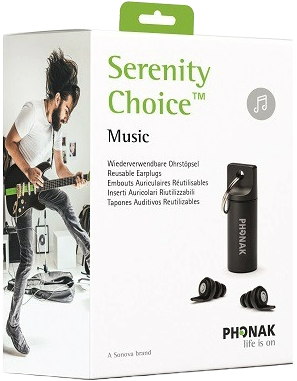
Introducing Phonak Serenity Choice Music
Phonak Serenity Choice Music earplugs are designed for concerts, festivals, clubs, rehearsals and other loud music environments.
Rather than simply stuffing the ear canal and heavily muffling everything, they use an acoustic filter intended to lower the sound while maintaining a more natural listening experience.
This means you can continue to enjoy:
- Vocals.
- Instruments.
- Bass.
- Crowd atmosphere.
- Conversation between performances.
The music remains recognisable and enjoyable, it is simply less intense.
Ideal for More Than Concerts
Serenity Choice Music earplugs may be useful for:
- Concerts and music gigs.
- Festivals.
- Nightclubs.
- DJ events.
- Band rehearsals.
- Musicians and performers.
- Bar and venue staff.
- Theatre productions.
- Loud fitness classes.
- Anyone regularly exposed to amplified music.
They are especially useful for people who love live music but find themselves avoiding events because of discomfort, ringing ears or sound sensitivity.
Position Matters
Earplugs are an important part of safer listening, but they are not the only thing you can do.
At a concert or festival:
- Avoid standing directly beside speakers.
- Move further back if the sound feels uncomfortable.
- Take occasional breaks in a quieter area.
- Give your ears time to recover between loud events.
- Keep your earplugs with you rather than waiting until the music feels painful.
- Make sure they are fitted correctly.
Pain is not the point at which sound first becomes risky. By the time your ears are physically uncomfortable, the volume may already be far higher than is sensible.
Put Them in Before You Need Them
It is easy to carry earplugs in your pocket and then forget to use them.
Try putting them in before the headline act starts or before entering the loudest area of the venue.
This gives your brain time to adjust. After a few minutes, the protected sound level often begins to feel completely natural.
When you briefly remove the plugs later, you may be surprised by just how loud the venue actually is.
What About Musicians and Regular Concertgoers?
People who regularly perform, rehearse or attend live music events have a greater cumulative exposure to noise.
Occasional universal earplugs can be an excellent starting point. Those who need protection frequently may also wish to consider professionally made custom earplugs.
The most important thing is to choose hearing protection that you are comfortable wearing consistently.
The best earplug is not necessarily the one with the greatest possible reduction. It is the one that provides appropriate protection, sounds natural enough and fits comfortably enough that you will actually use it.
Enjoy Music Now - and in the Future
Hearing damage is often gradual.
You may not notice a dramatic change after one event. Instead, certain sounds may slowly become less clear, conversation in background noise may become harder, or tinnitus may begin to appear more frequently.
Protecting your hearing today helps preserve your ability to enjoy music in the years ahead.
Wearing music earplugs does not mean you are being overcautious, getting old or spoiling the experience.
It means you value music enough to want to keep hearing it properly.
Explore Phonak Serenity Choice Music at Zova Sound Solutions and enjoy live music at a more comfortable level.